How to Read a Dog Food Label: The Complete Indian Pet Parent's Guide
You pick up a bag of dog food at the store. The front says "Natural", "Premium", "Grain-Free", and "Veterinary Formula" with a golden retriever frolicking…
How to Read a Dog Food Label: The Complete Indian Pet Parent's Guide
You pick up a bag of dog food at the store. The front says "Natural", "Premium", "Grain-Free", and "Veterinary Formula" with a golden retriever frolicking through a sunlit field. It looks healthy. It sounds healthy. But when you flip it over to read the actual label, it might as well be written in another language.
The ability to read a dog food label is one of the most powerful skills a pet parent can develop. It cuts through marketing noise, protects your dog from harmful ingredients, and helps you make genuinely informed choices about natural dog food. This guide gives you everything you need to decode any dog food label with the confidence of a veterinary nutritionist.
| 💡 Did You Know? In India, the Food Safety and Standards Authority of India (FSSAI) regulates pet food under the Food Safety and Standards (Food Products Standards and Food Additives) Regulations. However, enforcement of pet food labelling is still catching up with global standards — making it even more important for pet parents to be informed and vigilant. 🐾 Prefer not to worry about labels at all? Wagg N Dine uses 100% transparent, human-grade ingredients in every meal. What you see is what your dog eats — no decoding required. |
|---|
The Anatomy of a Dog Food Label: Five Critical Sections
Section 1: The Product Name — More Regulated Than You Think
The name on the front of a dog food pack carries a specific regulatory meaning under international guidelines (AAFCO), even if Indian regulations are still evolving. Key naming conventions to know:
- - "Chicken Dog Food" — Must contain at least 95% chicken (excluding water used in processing). This is a high-quality standard.
- - "Dinner With Chicken" or "Chicken Formula" — Needs to only contain 25% chicken. A meaningful drop.
- - "With Chicken" or "Chicken Flavour" — May contain as little as 3% chicken, or just enough flavouring to detect chicken by smell. Buyer beware.
The takeaway: the more prominent the protein name in the product title, the higher its proportion in the food, in theory. Always verify against the ingredient list.
Section 2: The Ingredient List — The Most Important Lines on the Label
Ingredients are listed in descending order of weight before cooking. The first five ingredients define the character and quality of the food. Here is how to assess them:
| ✅ What You WANT to See (First 5 Ingredients) | ⚠️ What to AVOID Seeing |
|---|---|
| Named whole protein: "Chicken", "Lamb", "Salmon" | "Meat meal" or "Animal by-products" — unnamed source |
| Named fat: "Chicken fat", "Salmon oil" | "Animal fat" — unidentified, variable quality |
| Whole vegetables: "Sweet potato", "Carrots", "Peas" | Corn syrup or sucrose — dogs don't need added sugar |
| Whole grains: "Brown rice", "Oats" | BHA, BHT, or ethoxyquin — synthetic, potentially carcinogenic preservatives |
| Natural preservatives: "Mixed tocopherols" (Vit. E) | Artificial colours (Red 40, Yellow 5, Blue 2) |
| Chelated minerals: "Zinc proteinate" | Propylene glycol — used in semi-moist foods; toxic to cats and harmful to dogs |
Section 3: The Guaranteed Analysis Panel
The guaranteed analysis panel shows the minimum or maximum percentages of key nutrients in the food. Here is what each value means and what to target:
| Nutrient | What It Tells You | Target Range (Adult Dog) |
|---|---|---|
| Crude Protein (min) | The minimum protein content | 18–26% (higher for active/large breeds) |
| Crude Fat (min) | Minimum fat content | 5–15% (breed and age dependent) |
| Crude Fibre (max) | Maximum fibre content | Under 5% for most adult dogs |
| Moisture (max) | Water content; affects nutrient density | Dry: <12% │ Fresh: 60–75% |
| Crude Ash (max) | Mineral content (calcium, phosphorus etc.) | Under 8%; high ash may stress kidneys |
| Omega-3 Fatty Acids | Anti-inflammatory fat (if listed) | 0.3–1.5% minimum (DHA + EPA) |
Note on moisture and dry matter basis: Because moisture content varies dramatically between food types, comparing kibble and fresh food directly on label percentages is misleading. To compare them fairly, calculate the "dry matter basis" by dividing each nutrient by (100 minus moisture percentage).
Section 4: The Nutritional Adequacy Statement
This is one of the most overlooked but critically important sections. It declares whether the food is:
- - "Complete and balanced for all life stages" — meets minimum requirements for puppies, adults, and pregnant/nursing dogs.
- - "Complete and balanced for adult maintenance" — meets requirements for healthy adult dogs only; not suitable for puppies or pregnant dogs.
- - "Intended for intermittent or supplemental feeding only" — this is not a complete diet and should not be fed as a primary food.
Always choose foods explicitly labelled as "complete and balanced" for your dog's life stage. Wagg N Dine's vet-approved meals are crafted to provide complete daily nutrition for dogs across all life stages.
Section 5: Feeding Guidelines
Feeding guidelines give a starting framework for how much to feed based on your dog's weight. However, these are estimates. Individual metabolic rates, activity levels, and health conditions all affect the true caloric need. Use guidelines as a baseline and adjust based on your dog's body condition score (visible waist, ribs palpable but not visible).
Red Flags That Should Make You Put the Bag Back on the Shelf
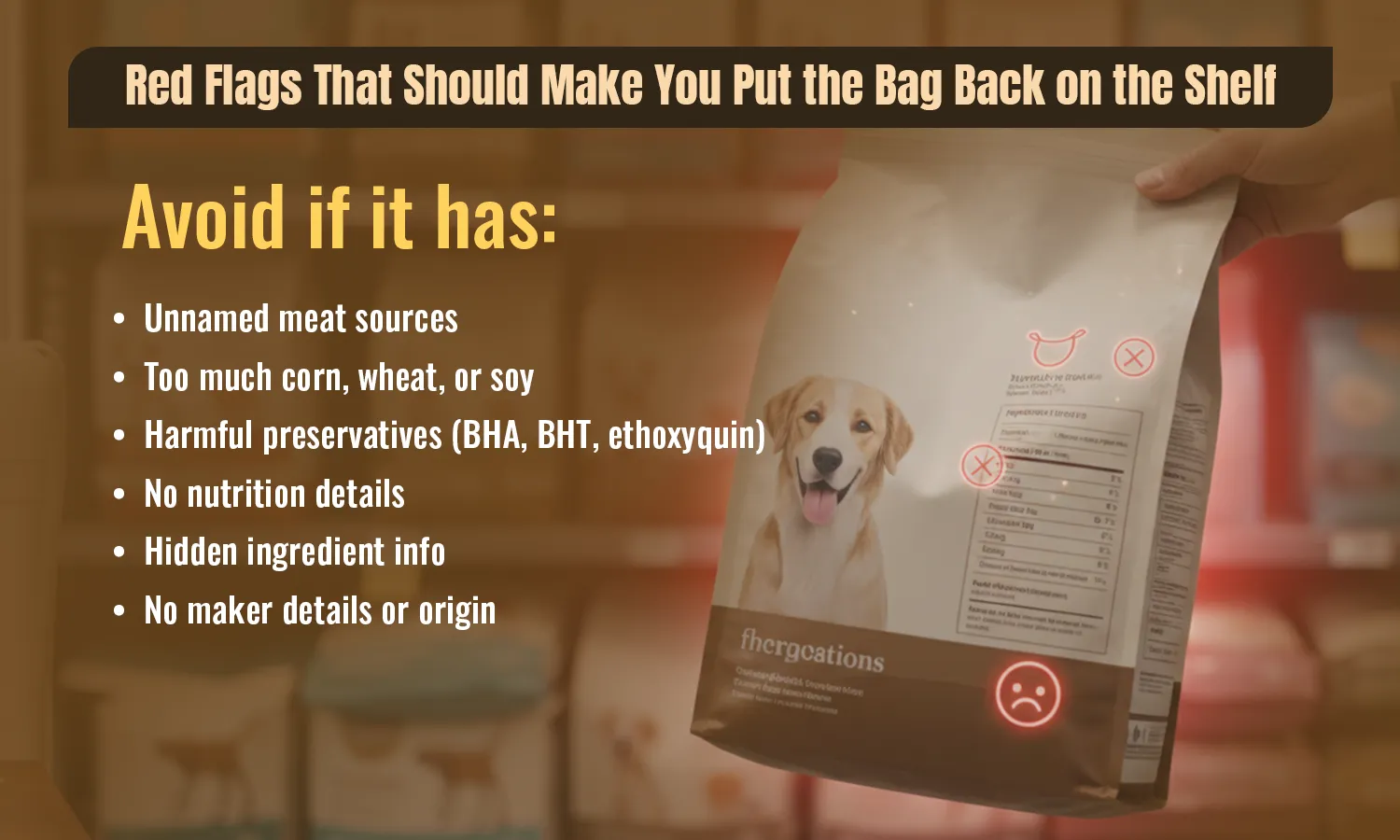
Regardless of the packaging claims, immediately question any dog food that contains:
- - Unnamed protein sources in the top 5 ingredients ("meat" without a species name)
- - More than one form of corn, wheat, or soy among the first five ingredients
- - BHA, BHT, or ethoxyquin as preservatives
- - No clear nutritional adequacy statement
- - "Proprietary formula" as a reason not to disclose ingredient proportions
- - No manufacturer contact information or country of origin
Why Wagg N Dine Makes Label Reading Unnecessary
Reading labels is an essential skill when you are buying commercially packaged dog food. But what if your dog's food had only three ingredients you could identify without a chemistry degree? Premium chicken. Fresh vegetables. Well-cooked white rice. That is Wagg N Dine's entire formula: no additives, no preservatives, no mystery.
Wagg N Dine was built on the belief that dog food should be as transparent as home cooking. When you know exactly what goes into your dog's bowl — because you can name every ingredient — feeding decisions stop being stressful and start being joyful.
| Tired of decoding labels? Switch to total ingredient transparency. ➜ Explore Wagg N Dine's Natural Dog Food → |
|---|
Frequently Asked Questions
What does 'human-grade' mean on a dog food label?
Human-grade means every ingredient meets the same safety, quality, and handling standards required for food intended for human consumption. It is the highest possible quality standard for dog food ingredients. Wagg N Dine uses 100% human-grade ingredients in all its meals.
Is 'grain-free' dog food automatically healthier?
No. Grain-free is a dietary format, not a quality indicator. Some grain-free diets are excellent; others replace grains with low-quality legumes that can cause nutritional imbalances. The FDA has investigated links between certain grain-free diets (high in peas and lentils) and dilated cardiomyopathy (DCM) in dogs. Consult your vet before choosing grain-free.
How do I compare dog foods with different moisture levels?
Use the dry matter basis calculation: divide each nutrient percentage by (100 minus the moisture percentage) × 100. This normalises the comparison across foods with different water content.
📖 Also read: How to Choose the Best Natural Dog Food for Your Pet | Learn about Wagg N Dine
Ready to switch to fresh, vet-approved meals?
Wagg N Dine cooks human-grade dog food fresh every day and delivers it to your door.
Explore Fresh Meals →