Puppy Nutrition 101: What to Feed Your Dog in the First Year of Life
Bringing home a puppy is one of life's most joyful experiences. It is also one of the most nutritionally critical periods in any dog's life. The first…
Puppy Nutrition 101: What to Feed Your Dog in the First Year of Life
Bringing home a puppy is one of life's most joyful experiences. It is also one of the most nutritionally critical periods in any dog's life. The first twelve months lay the biological foundations for everything that follows, including skeletal development, immune competency, neurological wiring, organ formation, and metabolic programming. What goes into that puppy bowl is not just food; it is architecture.
This comprehensive puppy nutrition guide is designed for Indian pet parents navigating the often-confusing world of puppy dog food. Whether you have a tiny Spitz, a growing Labrador, or a lanky Indian Pariah, these principles apply, and they will set your puppy up for a long, vibrant, healthy life.
| Key Principle: Puppies have roughly twice the caloric and nutritional demands of adult dogs of the same weight. They need more protein, more fat, more calcium, more phosphorus, and more DHA than adults — in precisely balanced proportions to avoid both deficiency and toxicity. Always consult your veterinarian before deciding on a puppy's diet, especially for the first 8 weeks. Ask your vet about Wagg N Dine's puppy-appropriate fresh meal options at waggndine.com/contact |
|---|
The Puppy Nutritional Timeline: From Birth to 12 Months
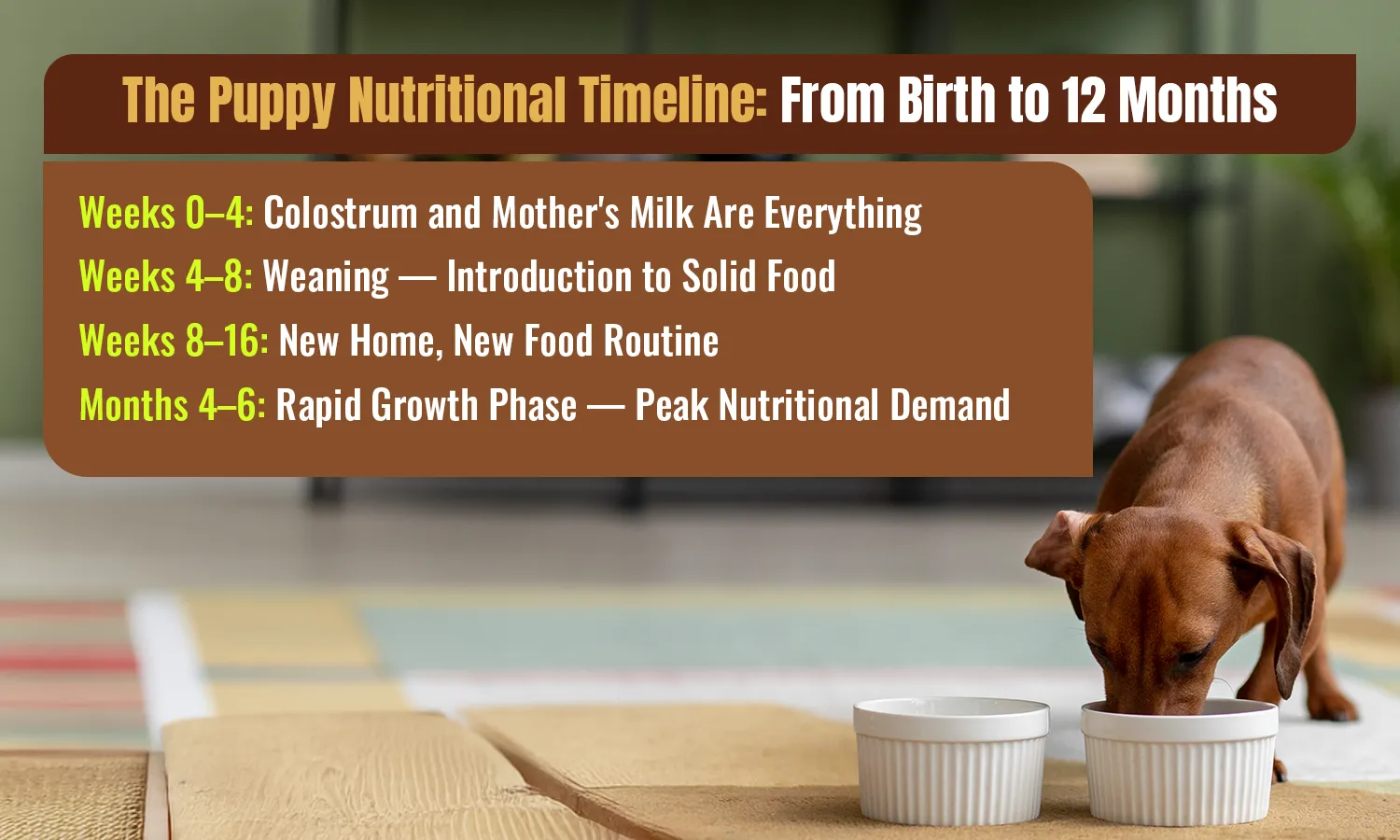
Weeks 0–4: Colostrum and Mother's Milk Are Everything
For the first four weeks of life, a puppy's nutritional world is entirely defined by their mother. Mother's milk provides the complete nutritional package — proteins, fats, antibodies (immunoglobulins), growth factors, and probiotics. The first milk, colostrum, produced in the first 48–72 hours after birth, is particularly critical: it transfers passive immunity to the puppy, providing initial protection against pathogens before the puppy's own immune system matures.
No dog food of any kind should be introduced before 3–4 weeks of age. If a puppy is orphaned or the mother is unavailable, consult your veterinarian immediately for a commercial puppy milk replacer (PMR). Do not use cow's milk — its lactose and protein composition is entirely unsuitable for puppies.
Weeks 4–8: Weaning — Introduction to Solid Food
Weaning begins around 3–4 weeks when puppies start showing interest in their mother's food. The process should be gradual, gentle, and low-stress. Here is a practical weaning protocol:
| Weeks 3–5 | Weeks 6–8 |
|---|---|
| Introduce puppy milk replacer in a shallow dish | Reduce PMR; increase solid food to 3–4 small meals daily |
| Begin mixing high-quality puppy food with warm water or PMR into a gruel | Transition to fully soft/moist solid food |
| Allow puppies to approach the dish voluntarily — never force-feed | Ensure food is species-appropriate and complete for puppies |
| Feed 4–5 times daily in very small portions | Begin individuation — separate feeding areas reduce competition |
Weeks 8–16: New Home, New Food Routine
Most puppies arrive in their new homes between 8 and 12 weeks. This is a period of enormous adjustment, with factors like new environment, new smells, new people, and the absence of littermates. Digestive stress is common. The worst thing you can do at this stage is introduce a sudden change in diet on top of all other environmental changes.
Transition strategy: Ask the breeder or rescue for the food the puppy has been eating and continue with it for at least 2–3 weeks. Once the puppy is settled, you can begin a gradual 10-day transition to a higher-quality natural dog food.
- - Feed 3–4 times daily, dividing the daily caloric allowance evenly
- - Measure portions using the feeding guidelines and adjust to body condition
- - Serve food at room temperature, since cold food can trigger digestive upset
- - Always have fresh water available; this is critical for kidney development
Months 4–6: Rapid Growth Phase — Peak Nutritional Demand
Between 4 and 6 months, most puppies enter their most rapid growth phase. Bone elongation, muscle mass accumulation, and organ development are at maximum intensity. This is the stage where nutritional deficiencies or excesses are most damaging and most irreversible.
Calcium and phosphorus balance is especially critical during this phase for large and giant breeds. Excessive calcium supplementation (from overzealous owners adding dairy or calcium tablets) can cause developmental orthopedic disease (DOD), including osteochondrosis and hypertrophic osteodystrophy. Conversely, insufficient calcium from low-quality dog food leads to rickets and skeletal deformities.
The safest approach: feed a complete and balanced, vet-approved puppy food that meets nutritional adequacy standards without supplementation. Wagg N Dine's recipes are designed to provide balanced calcium-phosphorus ratios appropriate for growing dogs.
Months 6–12: Adolescence — Slowing Growth, Stable Routine
By 6 months, most small and medium breeds have completed the majority of their bone growth. Large breeds may continue growing until 18–24 months. Transition from 3 meals to 2 meals daily at around 6 months. This is also the phase when you might consider transitioning from a puppy-specific formula to an "all life stages" food.
Neutering and spaying typically occur during this window (usually 6–9 months in India). Post-surgery, metabolic rate often decreases. Monitor body weight carefully and reduce portions if weight gain is observed.
Key Nutrients Puppies Need — And Why They Matter
| Nutrient | Why It Matters for Puppies | Recommended Level |
|---|---|---|
| Crude Protein | Muscle, tissue, enzyme, and immune system development | 28–34% (dry matter basis) |
| Crude Fat | Brain development, energy, and fat-soluble vitamin absorption | 17–25% (DM basis) |
| DHA (Omega-3) | Brain and retinal development; cognitive function | 0.1% minimum (DM basis) |
| Calcium | Bone and teeth mineralisation | 1.0–1.8% (DM basis) |
| Phosphorus | Bone structure; calcium: phosphorus ratio must be 1.2–1.4:1 | 0.8–1.6% (DM basis) |
| Vitamin D | Calcium absorption and bone mineralisation | 500–3,000 IU/kg food |
| Iron | Red blood cell formation; prevents anaemia | 80–100 mg/kg food |
| Zinc | Skin health, immune function, wound healing | 100–200 mg/kg food |
| Vitamin E | Antioxidant; immune development; natural preservative | 50 IU/kg food minimum |
How Much Should You Feed Your Puppy?
Puppy feeding quantities depend on three variables: breed size (small, medium, large, or giant), current body weight, and the caloric density of the food. The following table gives approximate daily feeding volumes for fresh food (around 1,400 kcal/kg as-fed):
| Puppy Size / Breed Type | Daily Fresh Food Amount (Approximate) |
|---|---|
| Toy / Small (< 5 kg adult weight) | 80–150 g/day split across 3–4 meals |
| Medium (5–20 kg adult weight) | 150–300 g/day split across 3 meals |
| Large (20–40 kg adult weight) | 300–500 g/day split across 3 meals |
| Giant (40 kg+ adult weight, e.g. GSD) | 500–800 g/day split across 3 meals |
These figures are starting estimates. Monitor your puppy's Body Condition Score (BCS) monthly. Ribs should be easily felt with light pressure but not visible. A visible waist behind the ribs and a slight abdominal tuck are signs of an ideal condition.
Common Puppy Feeding Mistakes to Avoid
- - Supplementing calcium without veterinary guidance — causes developmental bone disease in large breeds
- - Free-feeding (leaving food available all day) — leads to obesity and disrupts house-training routines
- - Feeding adult dog food to puppies — caloric density and nutrient profiles are insufficient for growth
- - Overfeeding "because they're growing" — excess calories in puppies directly cause obesity and joint stress in adulthood
- - Introducing too many different foods too quickly — causes GI upset and makes it harder to identify future intolerances
- - Giving cows' milk — puppies are lactose intolerant after weaning; cows' milk causes diarrhoea
- - Treating human table scraps as normal — creates fussy eating habits and risks exposure to toxic foods
Wagg N Dine and Puppy Nutrition
Wagg N Dine's freshly cooked chicken, vegetable, and rice meals provide the clean, high-quality protein and gentle carbohydrates that form an excellent nutritional base for growing puppies. The human-grade chicken supplies the essential amino acids critical for rapid muscle and organ development, while the fresh vegetables contribute natural vitamins and minerals.
For breed-specific puppy nutrition queries and to discuss whether Wagg N Dine's current meal formulations are appropriate for your specific puppy, we encourage you to reach out to our nutrition team directly.
| Your puppy's healthiest life starts in the bowl. Start it right. ➜ Contact Wagg N Dine's Nutrition Team for Puppy Advice → |
|---|
Frequently Asked Questions
When should I switch my puppy from puppy food to adult dog food?
Small breeds typically transition at 9–12 months; medium breeds at 12 months; large breeds at 18 months; giant breeds at 24 months. The switch should be gradual, over 10–14 days. Consult your vet for personalised guidance.
Can I feed my puppy home-cooked food?
Home-cooked food can be suitable if it is formulated by a veterinary nutritionist to meet puppy-specific requirements. DIY home cooking without professional guidance almost always results in nutritional deficiencies. A professionally formulated fresh food subscription like Wagg N Dine is a safer, more reliable alternative.
Is chicken good for puppies?
Yes, cooked, boneless, unseasoned chicken is an excellent high-quality protein source for puppies. It is easily digestible, rich in essential amino acids, and gentle on developing digestive systems.
How often should puppies eat per day?
8–12 weeks: 4 meals per day. 3–5 months: 3 meals per day. 6–12 months: 2–3 meals per day. Consistent meal times support digestive rhythm, house-training, and stable energy levels.
📖 Also read: How to Choose the Best Natural Dog Food for Your Pet | Read our pet parent stories
Ready to switch to fresh, vet-approved meals?
Wagg N Dine cooks human-grade dog food fresh every day and delivers it to your door.
Explore Fresh Meals →