Wet Dog Food vs. Dry Dog Food: Which Is Truly Better for Your Dog's Health?
It is the great dog food debate. On one side: the dry kibble that has dominated Indian pet store shelves for decades: convenient, affordable, and…
Wet Dog Food vs. Dry Dog Food: Which Is Truly Better for Your Dog's Health?
It is the great dog food debate. On one side: the dry kibble that has dominated Indian pet store shelves for decades: convenient, affordable, and seemingly complete. On the other: wet food, fresh food, and increasingly, freshly cooked natural dog food delivered on subscription — richer in moisture, more digestible, and increasingly preferred by veterinary nutritionists.
So which should you choose? The honest answer is nuanced, and this expert guide will give you every fact you need to decide confidently.
| Key Stat: Dogs consuming fresh or wet food diets have been shown to drink up to 40% less water while maintaining better overall hydration compared to dogs on dry kibble, because their food itself supplies moisture. (Source: Veterinary Record, 2022) 🐾 Wagg N Dine's freshly cooked chicken meals contain naturally high moisture levels, supporting your dog's hydration, kidney health, and digestion automatically, every single day. |
|---|
The Core Difference: It Starts With Moisture
The single most defining difference between wet and dry dog food is moisture content. Standard dry kibble contains approximately 8–12% moisture. Wet or canned dog food typically contains 70–80% moisture. Freshly cooked dog food, like Wagg N Dine's meals, sits at 60–75% moisture, the closest to what a dog would consume in a natural diet.
This difference has profound downstream effects on virtually every aspect of your dog's health, from kidney function and urinary tract health to digestion and even dental health. Understanding this single variable explains most of the debate.
Head-to-Head Comparison: Every Factor That Matters
| Factor | Dry Kibble | Wet / Fresh Cooked Food |
|---|---|---|
| Moisture Content | 8–12% | 60–80% (mirrors natural diet) |
| Hydration Support | Minimal — dogs must drink more | Excellent — food provides hydration |
| Protein Digestibility | Lower (heat extrusion damages) | High (gentle cooking preserves proteins) |
| Ingredient Quality | Often includes meal/by-products | Human-grade named proteins (e.g., chicken) |
| Preservatives Required | Yes — synthetic or natural | No — freshness replaced with delivery |
| Palatability | Moderate | High — dogs prefer it consistently |
| Caloric Density | High — easy to overfeed | Lower — portion control built-in |
| Shelf Life | 12–18 months | Fresh delivery; refrigerate up to 3 days |
| Dental Health | Some mechanical abrasion | Neutral (brush teeth separately) |
| Gut Microbiome Impact | Less diverse | More diverse, better health markers |
| Cost Per Day | Lower upfront | Moderate; offset by health savings |
| Convenience | Very high (long shelf life) | High with subscription delivery |
Why Hydration Is the Hidden Health Dividend of Wet and Fresh Food
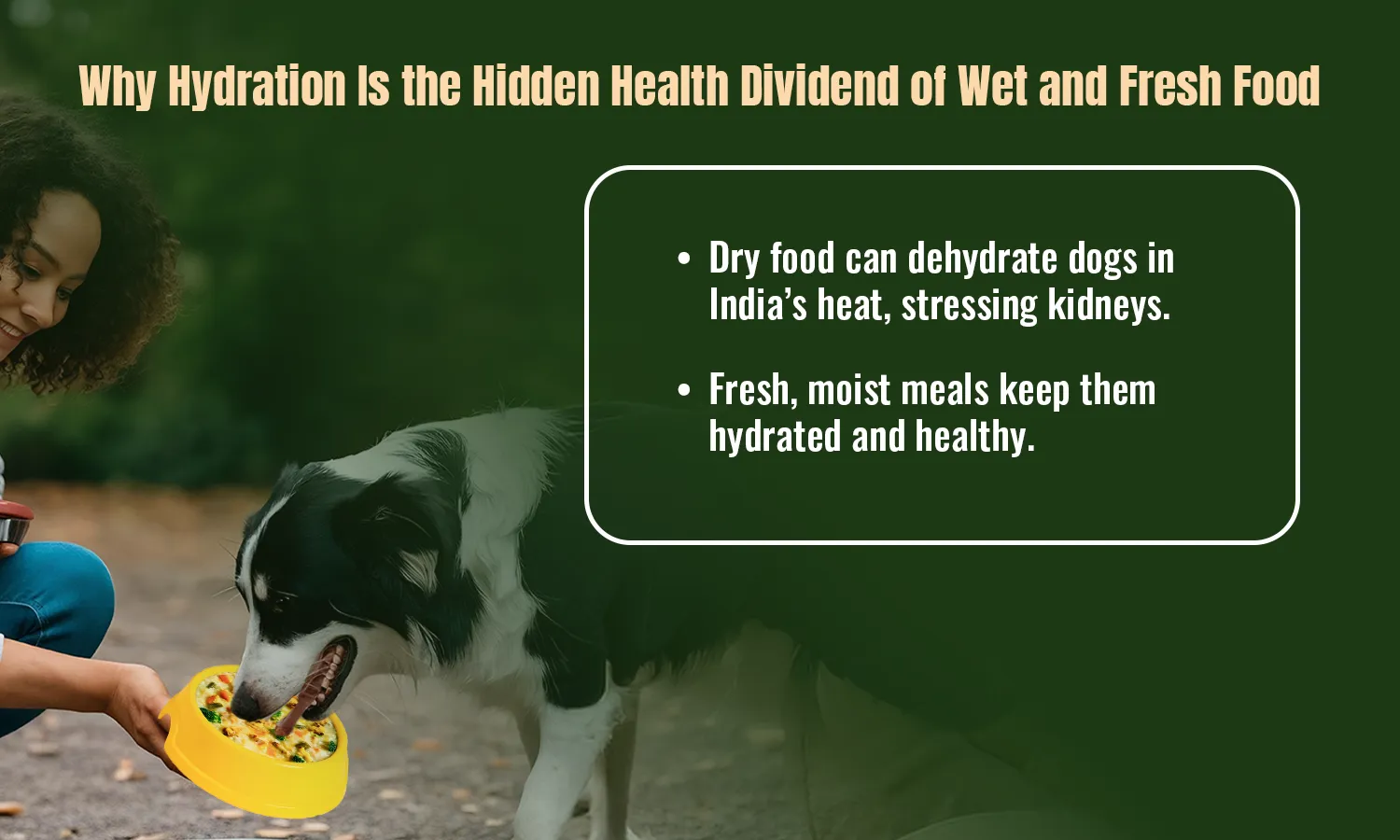
India's climate makes this factor particularly critical. In Chennai, Mumbai, Delhi, and most Indian cities, ambient temperatures push dogs toward chronic low-grade dehydration when they rely primarily on kibble. The kidneys bear the burden, working harder to concentrate urine and filter waste.
Long-term, this contributes to an increased risk of urinary crystals, kidney stones, and chronic kidney disease — among the most expensive and life-shortening conditions in senior dogs. Freshly cooked, moisture-rich dog food like Wagg N Dine's meals eliminates this risk by delivering hydration alongside nutrition in every bowl.
| 🔬 Veterinary Perspective Dr. Manish Kale, BVSc & AH, a small animal practitioner based in Chennai, explains: "In my clinical experience, dogs transitioned from dry kibble to moisture-rich, freshly cooked diets show noticeable improvements in coat quality, digestion, and energy within 3–4 weeks. The kidneys benefit significantly, especially in older dogs." The Journal of Nutritional Science (2023) published a systematic review confirming that dogs on high-moisture diets had measurably better urine dilution and lower urinary calcium oxalate concentrations — a direct marker of reduced kidney stone risk. |
|---|
The Digestion Factor: Why Gentle Cooking Wins
Standard dry kibble is produced through a process called extrusion: mixing raw ingredients into a slurry and forcing them through a high-temperature, high-pressure die. This process makes kibble shelf-stable, but it also degrades thermally sensitive nutrients, denatures some proteins, reduces enzyme activity, and can create acrylamide (a potentially harmful compound) in starchy ingredients.
Freshly cooked dog food uses gentle, low-temperature cooking that preserves protein structure, retains more vitamins and natural enzymes, and produces a meal that a dog's gut can absorb efficiently. This translates into firmer stools, less gas, reduced allergic reactions, and better overall absorption of nutrients.
When Dry Kibble Might Make Sense
For all its advantages, fresh and wet food is not the only option. There are scenarios where dry kibble makes sense as a primary or supplementary feed:
- - Budget constraints: Quality dry kibble is more affordable per day than fresh food, particularly for large or multiple-dog households.
- - Travel or outdoor activities: Kibble is the most practical feed for camping trips, long drives, or homes without refrigeration.
- - Dental abrasion: Some large-breed dogs benefit from the mechanical chewing action of hard kibble as part of dental maintenance (though this is not a substitute for regular brushing).
- - Emergencies: A bag of premium dry kibble is a useful backup when fresh food delivery is delayed.
If using dry kibble, choose options where a named protein source (chicken, lamb, or fish) is the first ingredient, artificial preservatives are absent, and whole grains or vegetables feature prominently.
The Third Option: Freshly Cooked Dog Food With Delivery
The traditional wet versus. Dry debate has largely been superseded by a third, superior category: freshly cooked, human-grade dog food delivered on subscription. Wagg N Dine sits squarely in this space, bridging the nutritional richness of wet food with the convenience of a delivery subscription, at a price point accessible to urban Indian pet parents.
Every Wagg N Dine meal is prepared fresh with premium chicken, farm-fresh vegetables, and well-cooked white rice, with no artificial preservatives, by-products, or fillers. It is portioned for your dog's size and delivered on a schedule you set. It is, simply, the best of everything.
| Why choose between wet and dry when you can have the best of both worlds? ➜ Try Wagg N Dine's Freshly Cooked Natural Dog Food → |
|---|
Frequently Asked Questions
Is wet dog food bad for dogs' teeth?
Not inherently. While wet food does not provide the same mechanical abrasion as dry kibble, it is not a direct cause of dental disease. Regular tooth brushing (recommended 3–5 times per week) is far more effective for dental health than relying on kibble abrasion.
Can I mix wet and dry dog food?
Yes, and many vets recommend mixing as a transitional strategy or for picky eaters. When mixing, reduce the quantity of dry food proportionally so total caloric intake remains appropriate for your dog's weight.
How do I know how much wet food to feed my dog?
Wagg N Dine's meals come pre-portioned based on your dog's weight, so the guesswork is eliminated. For other wet foods, use the feeding guidelines on the packaging as a starting point and adjust based on your dog's weight trends.
Is fresh-cooked dog food safe for daily feeding?
Absolutely, when the recipe is nutritionally complete and vet-approved, as Wagg N Dine's meals are. Daily fresh feeding is, in fact, the gold standard of natural dog nutrition.
📖 Also read: How to Choose the Best Natural Dog Food for Your Pet | See Wagg N Dine's meal plans
Ready to switch to fresh, vet-approved meals?
Wagg N Dine cooks human-grade dog food fresh every day and delivers it to your door.
Explore Fresh Meals →